


Injured in a Semi-Truck Crash in Kansas City? What You Need to Know.
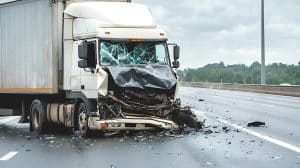
That danger showed up in a 2021 crash on US-69 Highway in south Johnson County, where a semi jackknifed and rolled over the median, shutting the highway down for hours. Here’s what happened, why truck cases are different from ordinary car-accident claims, and what your rights are in Missouri and Kansas in 2026.
What happened in the US-69 Highway truck crash?
A semi-truck jackknifed on US-69 Highway in south Johnson County early one Sunday around 7:30 a.m., rolling over the median in a violent crash. The wreck forced the highway to close in both directions between 199th Street and 207th Street for several hours. No one was injured.
US-69 is one of the busiest commuter corridors in the Kansas City metro, so a rollover like this snarls traffic across the Kansas side, and the outcome could easily have been far worse.
Why semi-truck crashes are more complex than car accidents
Truck accident claims are harder to handle than typical car-accident cases because they involve more potential defendants, federal regulations, and far higher stakes. A fully loaded tractor-trailer can weigh up to 80,000 pounds, which is about 20 times the weight of a passenger car, so injuries tend to be severe and the insurance policies far larger.
That combination is exactly why trucking companies send investigators to crash scenes fast. You need someone protecting your side of the story just as quickly.
Who can be held liable in a truck accident?
Liability in a truck crash often extends well beyond the driver. Depending on the facts, any of the following may share responsibility:
- The truck driver. The driver may be liable for fatigue, speeding, distraction, or other negligence.
- The trucking company. The company may be liable for the driver’s actions on the job, or for negligent hiring, training, or scheduling.
- The truck or trailer owner. If a separate company owns the equipment, they may share liability.
- A cargo loader. If improperly secured or overloaded freight caused the crash, the loading company may be partly responsible.
- A maintenance provider. If the maintenance provider didn’t properly repair or check the truck (for failing brakes, tires, or other neglected repairs), they may be liable.
- A parts manufacturer. If a defective component failed, the manufacturer may be to blame.
Identifying every responsible party matters, because each one may carry separate insurance coverage.
Common causes of semi-truck crashes
Common contributing factors in large-truck crashes include:
- Driver fatigue, which happens when a driver is driving past federal limits or while drowsy.
- Speeding or driving too fast for weather and road conditions.
- Distracted driving, including phone use.
- Improperly loaded or overweight cargo, which can cause rollovers.
- Poor maintenance of brakes, tires, or steering.
Two crash types are especially common with big rigs. A jackknife happens when the trailer swings out at a sharp angle to the cab, like a folding pocketknife. A rollover occurs when the truck tips onto its side or roof, often after a jackknife or a sharp maneuver, which is exactly what happened on US-69.
Federal trucking regulations that can affect your case
Truck drivers and carriers must follow Federal Motor Carrier Safety Administration (FMCSA) rules, and a violation can be powerful evidence of negligence. The core hours-of-service limits for property-carrying drivers are:
- 11-hour driving limit after 10 consecutive hours off duty.
- 14-hour on-duty window that the driver cannot drive beyond.
- 30-minute break required after 8 hours of driving.
- 60/70-hour weekly cap over 7 or 8 days.
Modern trucks log this data on electronic logging devices (ELDs). If those records show a driver was over their limit, that violation can support your injury claim, and in extreme cases may also be relevant to a claim for punitive damages, depending on the evidence and applicable state law.
Missouri vs. Kansas: deadlines and fault rules
Because the Kansas City metro straddles the state line, where your crash happened changes your deadline and your rights. This US-69 wreck was on the Kansas side.
- Statute of limitations: Missouri gives you 5 years from the date of injury to file most claims (RSMo § 516.120). Kansas gives you only 2 years (S.A. § 60-513).
- Shared fault: Missouri follows pure comparative fault, so you can recover even if you were partly to blame, reduced by your share (RSMo § 537.765). Kansas follows modified comparative fault with a 50% bar. This means you recover nothing if you’re 50% or more at fault (S.A. § 60-258a).
Kansas is also a no-fault state, so your own Personal Injury Protection (PIP) coverage is typically primary for covered PIP losses, even while you pursue the at-fault parties.
What to do after a truck accident
Immediately after a truck accident, there are some steps to follow to make sure you are able to file a claim and get the help you need.
- Get medical attention immediately, even if you feel okay. Serious injuries can surface days later.
- Call 911 and make sure a police report is filed.
- Photograph everything: the vehicles, the scene, and the truck’s company name and U.S. DOT number.
- Collect witness names and contact information.
- Don’t give a recorded statement or accept a quick settlement before talking to a lawyer.
- Some ‘black box’ and other electronic data can be overwritten, while carriers generally must retain ELD records for six months.
- Contact a truck accident attorney to investigate and deal with the carrier’s insurers for you.
Taking these steps can help you with a claim in the future.
Truck accident FAQs
- How long do I have to file a truck accident claim? In Missouri, you generally have five years from the date of injury. In Kansas, you have just two years, so don’t wait.
- Who pays for my injuries in a truck accident? Often the trucking company’s insurer, not just the driver’s. Several parties may share liability, and each may carry its own coverage.
- Can I sue the trucking company instead of just the driver? Yes. Companies are usually responsible for their drivers’ on-the-job conduct and may be independently liable for negligent hiring, training, or scheduling.
- What is a jackknife accident? It’s when a truck’s trailer swings out and folds toward the cab at a sharp angle, often causing the driver to lose control.
- What if the truck driver wasn’t hurt but I was? That’s common; most people killed or injured in truck crashes are in the smaller vehicle. You can still pursue a claim for your injuries regardless of whether the trucker was harmed.
Injured in a Kansas City truck crash? Talk to us today.
Trucking companies move fast to protect themselves after a crash. You deserve a team that moves just as fast for you. Kansas City Accident Injury Attorneys investigates every responsible party, preserve the evidence that wins cases, and deliver the care and attention our clients count on. If you lost a loved one, our wrongful death lawyers are here to help. Contact us today for a free consultation.

Kansas City personal injury attorney James Roswold of Kansas City Accident Injury Attorneys handles cases dealing with victims of personal injury, medical negligence, wrongful death, workers compensation, nursing home negligence, premises liability, product liability, car accident, truck accident and motorcycle accident cases.